Immediate Safety
We remove the imminent threat, allowing you and your family to sleep soundly or regain access to your property.
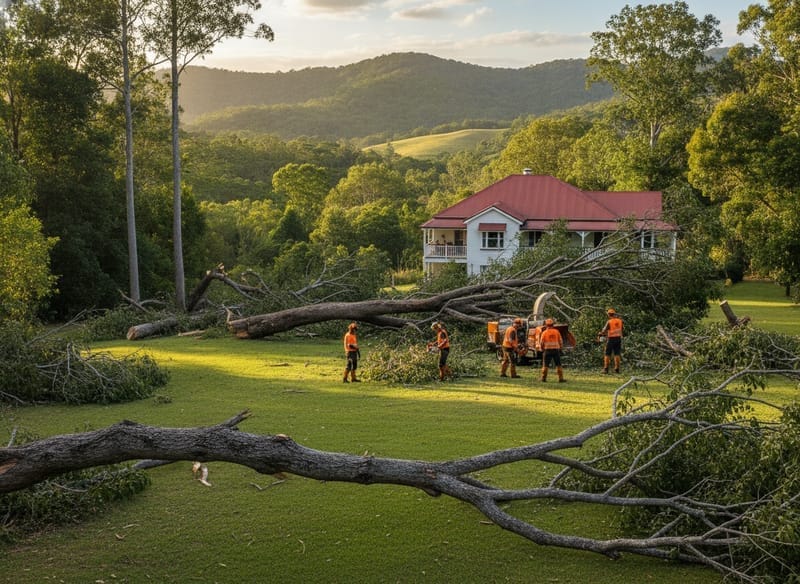
We make safe and remove fallen, snapped, or imminently dangerous trees threatening your home or access.
Dispatch to Bunya, Samford Valley, and the Hills District.
Our emergency tree service focuses on immediate hazard mitigation, protecting your family, home, and property.
Bunya’s large open eucalypt forests are highly susceptible to sudden limb failure during intense summer storm cells off the D'Aguilar Range, causing sudden, catastrophic property risks.
We remove the imminent threat, allowing you and your family to sleep soundly or regain access to your property.
Securing a cracked or leaning tree before it completely fails prevents thousands of dollars in further property damage.
We take control of the situation, handling the heavy lifting, the danger, and the paperwork for your insurer.
Call us. We assess the urgency over the phone and dispatch our crew.
Upon arrival, our primary goal is to secure the area, isolate the hazard, and stop further damage.
Using safe, specialised techniques, we dismantle the dangerous timber.
We clear the debris and provide the necessary paperwork for your insurance claim.
When a severe summer storm rolls through the Hills District, the aftermath can be devastating for acreage properties. If you are facing a fallen hoop pine over your driveway or a shattered flooded gum threatening your roof, our team provides fast, professional Emergency Tree Removal Bunya property owners can rely on. Living in this beautiful, leafy suburb means sharing your space with massive, mature trees. But saturated soils during the wet season, high winds, and sudden limb failures can turn these gentle giants into immediate hazards. We are your local Hills District Arborist team, ready to deploy our trucks, chippers, and qualified climbers to secure your site. Whether a tree has already collapsed onto a fence or you have a massive hung-up branch ready to drop, our help focuses on making your property safe. We understand the stress of unexpected tree failures, and our priority is securing your home, your family, and your access points.
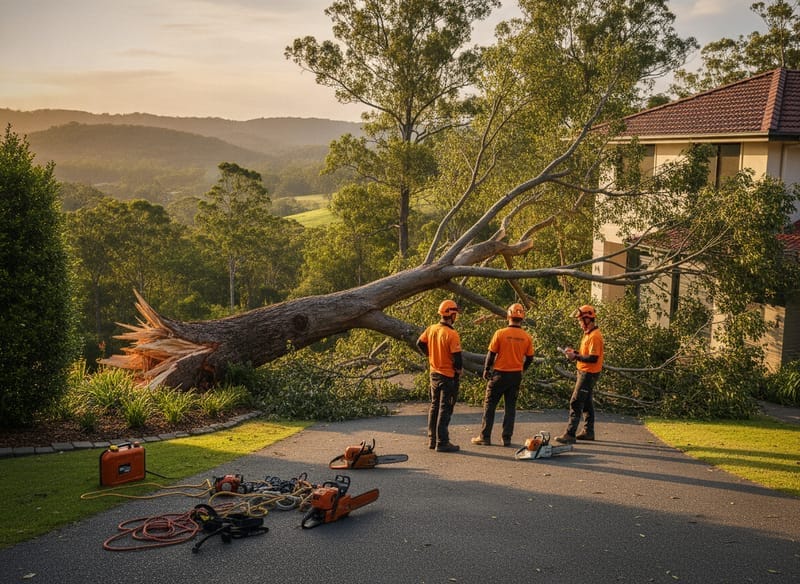
Dealing with a storm-damaged or uprooted tree is arguably the most dangerous task in arboriculture. Unlike standard felling, a collapsed tree is under unpredictable tension and compression forces. If an unqualified operator or a homeowner with a chainsaw cuts the wrong limb, the entire trunk can snap back, roll, or drop violently.
Unfortunately, storm season often brings out opportunistic "loppers" who lack the necessary AQF Level 3 qualifications or adequate public liability insurance. Hiring under-qualified operators for a complex emergency can result in further damage to your home, catastrophic injury, and rejected insurance claims.
Our experienced climbers and ground crew approach every hazardous situation with calculated precision. We don't just hack away at the debris. We assess the load, plan the cuts, and use specialized rigging to dismantle the hazard safely. Even in emergency scenarios, our pruning and make-safe cuts adhere closely to AS4373 (Pruning of Amenity Trees) standards to preserve the health of any remaining canopy that can be saved.
By trusting our qualified arborists, you ensure the job is done safely, legally, and in a format that your home insurance provider will readily accept.
When we dispatch our crews to a critical failure, we bring specialized equipment and techniques tailored to the specific hazard. Here is how our arborists handle complex emergency removals.
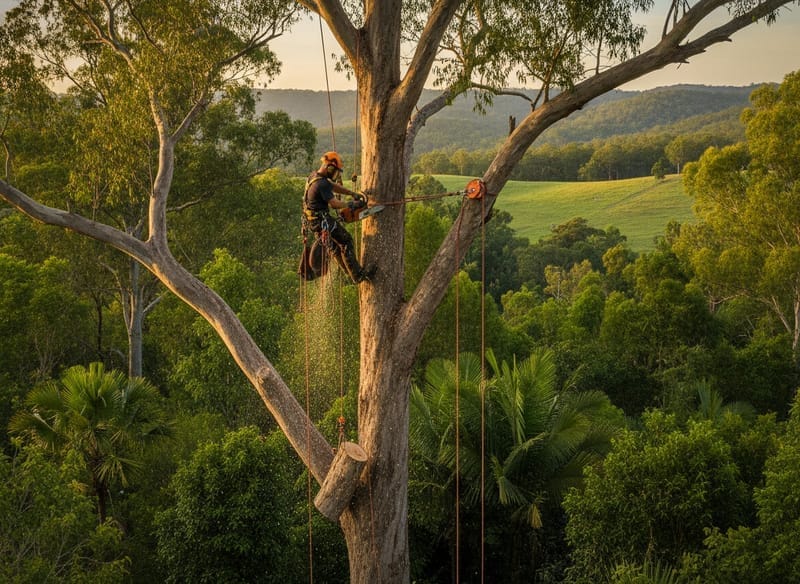
For steep gully blocks in Bunya where elevating work platforms (EWPs) cannot reach, our AQF Level 3 climbing arborists use advanced single and double rope-access techniques. We isolate the damaged sections and lower heavy limbs under friction control to prevent any secondary damage to the structures below.
Uprooted or snapped trees, like massive flooded gums, are highly volatile. Our chainsaw operators are trained to read the dynamic forces trapped in the timber. We perform precise relief cuts to safely release tension before sectioning the trunk, preventing dangerous kickbacks.
When a massive hoop pine or Moreton Bay fig fails directly over a house, we often deploy crane-assisted removal methods. This allows us to safely lift multi-ton sections of timber straight up and away from the roofline, minimizing risk and speeding up the entire make-safe process.
For trees leaning dangerously toward power lines or neighboring boundaries, we utilize heavy-duty winches, the Good Rigging Control System (GRCS), and mini-loaders to anchor and safely pull the tree in the opposite direction while it is safely felled.
When you call us, every minute counts. We have streamlined our procedure to get our team to your property quickly and safely. - Initial Triage and Dispatch: When you call, we will ask for photos if it is safe to take them, and determine the immediate risk level. We will then give you a clear ETA for our crew's arrival. - Site Risk Assessment: Upon arrival, our Senior Arborist conducts a rapid but thorough hazard assessment. We identify powerline risks, structural dangers, and the stability of the root plate before anyone approaches the drop zone. - Make-Safe Operations: The priority is removing the threat to life and property. We will secure leaning trunks, remove hung-up branches, and clear accessways. In the middle of a severe weather event, we may leave the processed timber safely on the ground and return in daylight for the final cleanup. - Insurance Documentation: We provide you with comprehensive pre-work photos, written arborist notes, and an itemised invoice formatted specifically for your insurance provider to streamline your claim. - Complete Removal and Cleanup: Once the immediate danger is neutralized, our team will cut the timber to your specified length, process the canopy through our wood chippers, and leave your acreage safe and tidy.
Emergency situations require absolute certainty in compliance and safety protocols. Our team operates with comprehensive Public Liability insurance and full WorkCover for all employees.
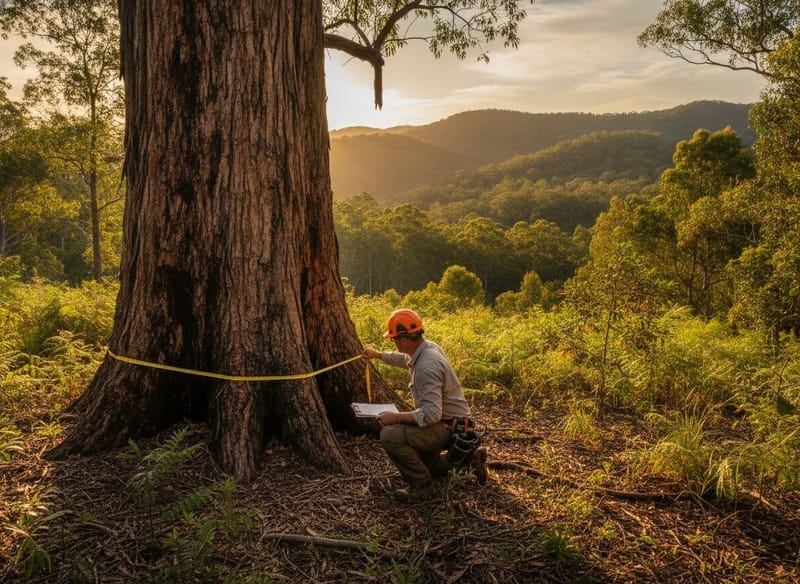
Every arborist on our crew holds a minimum AQF Level 3 in Arboriculture, while our consulting arborists hold AQF Level 5 diplomas, allowing us to provide formal risk assessment reports if required by your insurer. We comply strictly with AS4373 for any retention pruning and AS4970 for protecting surrounding trees during machinery access. Furthermore, our operators maintain all required tickets, including Working at Heights and EWP operation, ensuring every emergency job is conducted strictly by the book.
Bunya properties present a unique mix of steep terrain, narrow acreage driveways, and towering native species. Responding to an emergency here requires deep local knowledge of both the environment and the laws.
We frequently deal with large hoop pines and bunya pines that have shed heavy limbs or suffered complete root plate failure after weeks of summer rain. Additionally, because Bunya falls under the City of Moreton Bay planning scheme, many properties sit within vegetation protection or Koala Habitat Areas.
Usually, removing a protected tree requires a lengthy permit process. However, under council regulations, trees that are dead, dying, or posing an imminent threat to life or property can generally be removed under emergency exemption provisions. Our team will guide you through this process. We provide the necessary written arborist assessment and photographic evidence to prove the tree was a critical hazard, ensuring you remain fully compliant with local council laws.
Once the emergency tree removal is complete, there are a few important steps you should take. First, keep a copy of our arborist report and the before-and-after photos handy for your home insurance claim. If the failed tree was part of a larger stand of timber, we highly recommend having our AQF Level 5 consulting arborist assess the remaining trees. Storm winds that bring down one flooded gum often weaken or destabilize the root systems of neighboring trees. Finally, monitor the remaining stump and surrounding soil for any sudden sinking or pooling water. If you notice nearby trees showing signs of canopy dieback or leaning in the weeks following a severe weather event, call our team for a follow-up inspection.
Emergency tree work carries higher risks and after-hours costs, but we maintain transparent, competitive pricing.
We provide a clear estimate of costs before commencing any make-safe work on site.
Dispatch available to the following areas:
Don't wait. Call our team for professional hazard removal.
Call Now 0468 169 959