Usable Acreage
Convert overgrown scrub into beautiful, grazing-ready pasture or clear sightlines.
Professional vegetation management and land clearing for acreage properties, new builds, and bushfire compliance.
Heavy clearing services for Dayboro and the Mt Mee foothills.
Our Land Clearing Dayboro service provides heavy-duty vegetation management for tree changers, acreage owners, and developers.
Dayboro's mix of koala habitat and steep forested blocks requires careful, compliant clearing. We know how to navigate council rules while getting your land ready.
Convert overgrown scrub into beautiful, grazing-ready pasture or clear sightlines.
Dramatically reduce the fuel load around your homestead ahead of the fire season.
Ensure your earthworkers and builders have clear, safe access to the site.
We walk the boundaries, mark trees for retention, and check council overlays.
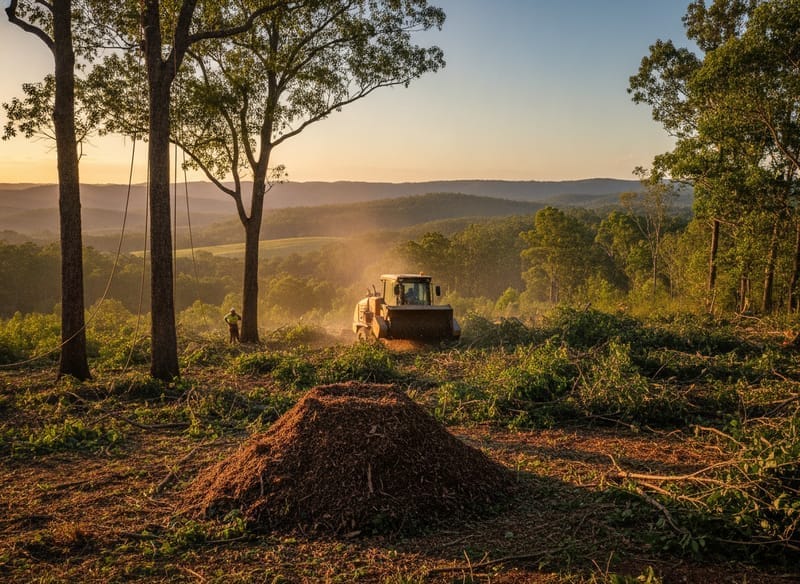
Undergrowth and woody weeds are mechanically mulched first.
Targeted trees are safely felled, chipped, or processed into logs.
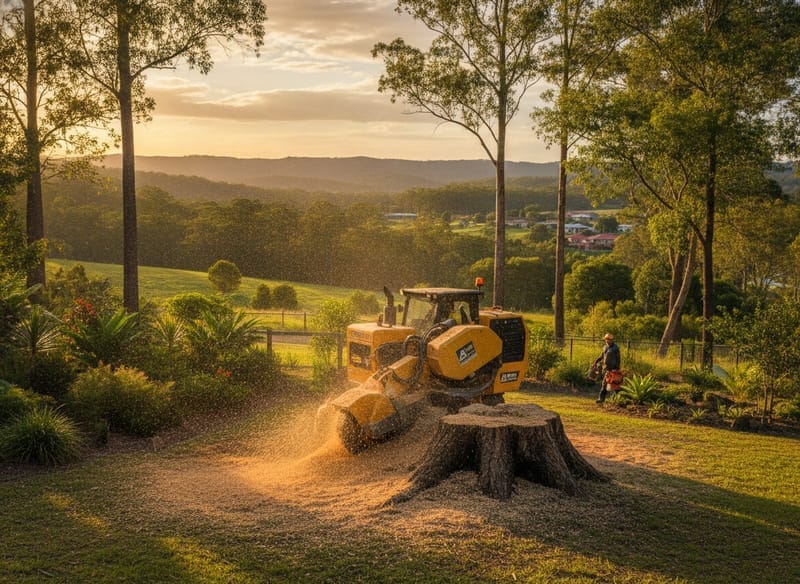
Stumps are ground out, and mulch is spread evenly to prevent erosion.
When you are preparing a new acreage block, managing bushfire risks, or expanding a paddock, professional Land Clearing Dayboro is the essential first step. Dayboro’s beautiful but rugged landscape features steep hinterland blocks, heavy seasonal rains, and densely vegetated gullies. Clearing a site here is rarely as simple as just rolling in a bulldozer.
Whether you are a homeowner building a dream rural retreat, a developer preparing a subdivision, or an acreage owner managing overgrown scrub, our team provides safe, systematic vegetation removal. We understand that clearing land isn't just about knocking trees down; it is about proper environmental management, preserving soil stability, and retaining the right native trees to maintain the character of the Hills District.
With our own fleet of heavy machinery, wood chippers, and AQF-qualified climbers, we handle every aspect of the clearing process, from initial council compliance checks to the final site clean-up.
Slashing and bulldozing a block without an arborist-led strategy often leads to disastrous consequences. One of the biggest problems we see with under-qualified operators is the indiscriminate destruction of vegetation, which frequently breaches City of Moreton Bay planning schemes or state vegetation management laws. Illegal clearing of protected species or mapped koala habitat can result in staggering fines for the property owner.
Furthermore, aggressive mechanical clearing can devastate the root systems of the trees you actually want to keep. When heavy machinery tears through a site, it compresses the soil and rips through the Structural Root Zones (SRZ) of retained timber. Within a few years, those 'saved' trees often fall into severe decline, drop major limbs, or become hazardous deadwood.
Our team approaches site clearing differently. We operate in strict alignment with AS4970 (Protection of Trees on Development Sites), ensuring that retained legacy trees—like mature hoop pines or flooded gums—are properly cordoned off and their root zones protected. We selectively dismantle trees where heavy machinery cannot go, mitigating soil erosion on steep slopes and leaving you with a clean, legally compliant, and stable block ready for your next project.
We do not rely on a one-size-fits-all approach. Our arborists and machinery operators deploy specific clearing methods tailored to your block’s terrain, council overlays, and end-use goals.
We systematically remove vegetation within your designated building footprint. This includes the precise felling or climbing dismantling of large timber, followed by the extraction of undergrowth. We process all green waste through our high-capacity chippers, leaving your site accessible for builders and earthworkers.
For properties carrying BAL (Bushfire Attack Level) ratings under AS3959, we establish and maintain Asset Protection Zones. This involves selective clearing of understory scrub and strategic thinning of the canopy to reduce fire fuel loads, while retaining key shade trees at safe distances from structures.
Overgrown boundaries restrict access and damage agricultural fencing. We clear linear corridors through thick vegetation, utilizing skid steers and ground crews to safely drop and process timber. We can leave the resulting mulch on-site for weed suppression or transport it away entirely.
Often required for ecological management, this method involves manually targeting weed species like camphor laurel while actively preserving native saplings, rainforest remnants, and mapped koala habitats. We use directional felling and climbing techniques to ensure protected flora remains completely untouched.
Every successful project requiring Land Clearing Dayboro starts with a comprehensive site assessment by our senior arborists. We visit your property to evaluate the terrain, identify specific tree species, and map out the required machinery access points. During this visit, we cross-reference your clearing goals with the local City of Moreton Bay planning scheme to ensure no protected vegetation is disturbed without proper permits.
Once the scope and compliance are confirmed, we provide a detailed, transparent quote. On the day of the job, our team arrives with our own fleet of tipper trucks, heavy-duty chippers, and specialized access equipment. We begin by establishing Tree Protection Zones (TPZ) around any trees designated for retention.
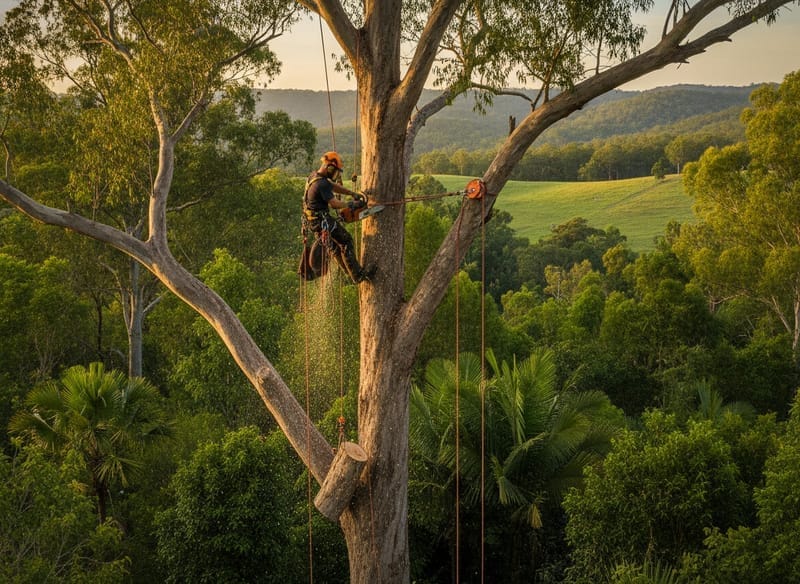
The clearing phase is executed systematically. For steep gully areas where machinery cannot safely operate, our AQF Level 3 climbing arborists use rope-access techniques to dismantle trees piece by piece. On flatter, accessible ground, we utilize directional felling and skid steers to efficiently gather and process the timber.
Finally, we process the debris. Depending on your preference, we can grind the stumps below grade, turn the timber into valuable garden mulch for your property, or completely haul away all green waste, leaving a pristine, workable site.
Land clearing is high-risk work that demands uncompromising safety standards. Our business is fully backed by Public Liability insurance and comprehensive WorkCover for all our employees. You are protected at every stage of the project.
Our operations are led by AQF Level 3 climbing arborists and overseen by AQF Level 5 consulting arborists when formal reports or AS4970 tree protection plans are required for Development Applications. Whether we are operating heavy chainsaws, setting up traffic management on narrow hinterland roads, or navigating tight drop zones, our crew adheres to strict Safe Work Method Statements (SWMS) to ensure zero harm to people, property, and the surrounding environment.
Working in the Hills District requires specific local knowledge. The terrain around Dayboro often transitions from rolling paddocks to steep, slip-prone gullies holding remnant subtropical vegetation. Heavy seasonal rains can saturate these volcanic soils, meaning heavy machinery must be carefully managed to prevent deep rutting or slope failure.
The City of Moreton Bay actively enforces vegetation management, especially within mapped Koala Habitat Areas and biodiversity corridors. Significant local trees, such as towering hoop pines, flooded gums, and century-old Moreton Bay figs, often require specific council exemptions or development approvals before they can be removed.
Our team understands these local overlays intimately. We know when to utilize track-mounted spider lifts for minimal ground disturbance and when rope-access climbing is the only viable option for steep hinterland blocks. We handle the logistical headaches—including negotiating narrow, winding rural driveways with our heavy trucks—so your site clearing proceeds without delay.
Once the heavy clearing is complete, proper site management is crucial to prevent erosion and weed overgrowth. We typically recommend retaining the chipped green waste on-site; spreading a thick layer of native mulch helps stabilize exposed soil, retain moisture, and suppress invasive weeds while your builders or landscapers get to work.
If you have retained mature trees on the newly cleared block, they will suddenly be exposed to different wind loads and sunlight. We recommend having our arborists return after 12 months to assess these trees for wind-throw stability and to perform any necessary AS4373-compliant formative pruning. Additionally, if you need deeper earthworks later, call us back for targeted stump grinding to clear the subterranean root masses.
Land clearing is highly variable and priced by the size of the area and density of the vegetation.
We provide detailed, fixed-price project quotes or daily machinery rates.
Providing heavy land clearing across the acreage belt.
Contact us today to discuss your land clearing and bushfire prep needs.
Get a Free Quote